
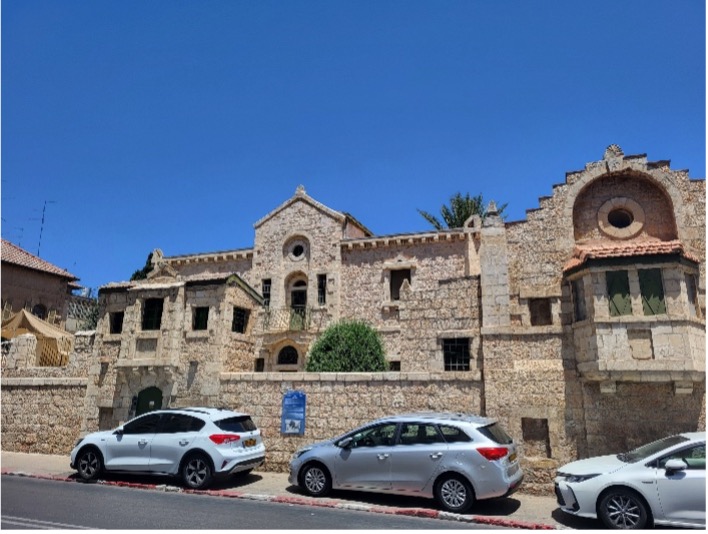

I had the privilege of receiving a Moerthen fellowship to spend July and August 2025 at the Swedish Theological Institute (STI) in Jerusalem. STI is located just a few minutes’ walk from Damascus Gate, one of the main entrances to the Old City of Jerusalem. Anna Hjälm, the Director of the Institute, and her staff members, were very welcoming and extremely helpful.
During my time at the STI, I met Swedish and other European visitors who were also resident there. We quickly formed a close group, often spending our evenings together in the Christian Quarter, where we met many other Europeans. These informal encounters were deeply enriching. We came from diverse backgrounds and life trajectories, yet shared a desire to understand the region in its complexity.
Few places in the world bring so many religious traditions into such close proximity, not only through sacred sites but through everyday communal life. Jerusalem reminds me of a widely circulated poem, often attributed to the Palestinian poet Sami Muhanna:
“When you are asked who you are, say:
I am from the land of faith,
from a country of all religions.
I am from where I heard the bells of churches
and the call to prayer.”
This understanding of Jerusalem as a place of multiple religious traditions became tangible when one of the people I spent time with showed me his arm, tattooed with symbols of different faiths. The tattoo had been done by a well-known Palestinian tattoo artist in the Christian quarter. He explained that the impact of Jerusalem would always remain with him, engraved quite literally into his body.
The Swedish Theological Institute is exactly the kind of place where such personal encounters can unfold. At the same time, it also offers a vibrant professional and intellectual environment. During my stay, STI hosted a reception in their beautiful garden, bringing together Swedish politicians and representatives from Human Rights Organisations, including the Augusta Victoria Hospital. This social gathering, gave me the opportunity to introduce my new European Research Council funded Consolidator Grant project, Governing Health, Family and Religion: The Biopolitics of Genetic Counselling and Religious Family Formations (RELI-GENE), based at the School of Oriental and African Studies, University of London. The evening became an important moment for building connections with healthcare providers, policymakers and activists and for discussing how genetic counselling and marriage regulation are experienced across diverse religious minority communities in Jerusalem and in the wider region. This evening marked the beginning of conversations that will continue to shape my research.
I also joined Anna and her team on a visit to the house of Sally Azar, the Palestinian female pastor of the Evangelical Lutheran Church of Jordan and the Holy Land Jerusalem congregation, located within the Augusta Victoria compound on the northern side of the Mount of Olives in East Jerusalem.

The traditional Palestinian Holy bread for Sunday service, Jerusalem: © YShanneik
The visit included a communal evening during which we observed the preparation of a distinctive Palestinian Christian bread for the Sunday service, made out of grape molasses. The evening developed into conversations about Palestinian heritage and the ways in which religious practices are shaped by place, material cultural and local traditions. As Sally explained, the use of grape molasses in the holy bread is deeply rooted in longstanding Palestinian Christian ritual practices and reflects the intimate connection between faith, land and communal oral traditions.
On the 8 September 2025, I organised a roundtable discussion at the STI on Reproductive Governance and Kinship in Minority Communities, in collaboration with Lund University and Moerthen. This informal gathering brought together academics, researchers, and health professionals working with different minority communities across the region. The aim was to create a shared space for dialogue, where participants could exchange perspectives and reflect on their experiences in both research and practice. The discussion explored how state systems and national health guidelines influences choices around marriage and reproduction and the strategies communities develop in response. Participants also reflected on the challenges faced by healthcare providers and policymakers as they navigate diverse religious and cultural understandings of family and kinship.
What distinguished the roundtable was the diversity of voices present. Participants included representatives of and scholars working on Muslim and Christian Palestinians, Palestinian Bedouin communities, Druze, Circassians, Samaritans, Ultra-Orthodox as well as Ethiopian Jews. I came to realise that organising a multi-faith event in Jerusalem, and at the STI in particular, requires specific sensitivity to religious boundaries. As the STI is an active church on consecrated grounds, some participants from other faith traditions did not feel able to attend in person. Members of the Ultra-Orthodox Jewish communities, in particular, expressed discomfort with physically being present at the venue and therefore requested that the roundtable takes place in a hybrid format. Accommodating these preferences allowed voices that might otherwise have been absent to take part in the conversation. All participants contributed multiple layers of knowledge that enriched current scholarship on the topic by drawing on their research, professional practice and direct engagement with communities. We highlighted the importance of cross-disciplinary and trans-religious exchange and of the need to understand how religion, health and social norms and everyday life of individuals are deeply interconnected.
This roundtable also marked the starting point of my RELI-GENE project. Over the next five years, these conversations will continue to develop across different sites and minority communities. My team and I look forward to returning to the Swedish Theological Institute and to deepening our collaboration through future research and shared reflections.
