
Magdalena Dziaczkowska:
I was afraid to go back to Jerusalem. Jerusalem for me is a world of its own, where I have spent almost 5 years already, and which made me into a person that I am today. No place was as transformative for me as Jerusalem, perhaps because of the weight it has historically, spiritually and politically. The weight of the glory, as a friend joked once, playing with Hebrew words glory (kavod)and heaviness (koved). It is a glorious place but also very heavy and pregnant with suffering, so if you are not prepared, its weight can smash you.
My previous research stay in Jerusalem ended in autumn 2022, amid rapidly intensifying political polarization and attempts to weaken Israeli democracy. Since Covid, aggressive security measures, a collapsing tourism sector, and increasing restrictions on Palestinians had severely weakened the economy. Many Palestinians lost their livelihoods. At the same time, religious right-wing groups gained strength, leading to greater boldness among West Bank settlers and sporadic violence against Arabs inside Israel. The tension was palpable. When I left in September 2022, I was angry, frustrated, and exhausted, expecting an escalation of the Israeli-Palestinian conflict—perhaps another intifada. What followed, however, was unimaginable. October 7 changed everything. One of my former colleagues, Alex Dancyg, a pioneer of Polish-Jewish reconciliation, was taken hostage and killed in March 2024. My heart sank. The destruction of Gaza and messages from Church leaders and humanitarian colleagues were beyond despair. I dreaded the future.
I was supposed to return to Jerusalem in October 2023, and my bags stayed packed for another year as the situation failed to improve. When I finally had the opportunity to go this November, I was filled with apprehension. Ethical questions intertwined with emotional struggles: How are my friends and colleagues—Israelis and Palestinians, Jews, Christians, and Muslims—and how can I show up to their pain, mourning and anger? What can one say to those who have lost relatives and friends and are devastated? Is it acceptable to focus on my own research while so much suffering continues? Do I have the psychological resources to spend two months there? As always in life, there was only one way to find out: by going. And, as usual, the resources somehow emerged, sometimes in unexpected ways.
Despite the difficult general situation, Jerusalem was very calm. Given how crazy busy this city usually gets, I appreciated the silence, but I noted growing indifference or maybe numbness? I spent most of my days in the archives of Yad Vashem, silent and removed, with beautiful views over Ein Karem. Taking a tram from the stop Yafa Mercaz to Mount Herzl and then walking from there, with a view of beautiful hills and forests, provided some space and isolation from the city noise. It gave me time to think, breath fresh air, and clear my head before emerging myself into the historical records of the Holocaust.
Archive research is a lonely and slow business. You spend hours browsing through mysterious databases, sometimes built in an even more mysterious way. You try various spellings of the names, synonyms, various level of accuracy etc. And sometimes you find fascinating information. Some other days, you browse in vain, cursing the database. It is all part of the process.
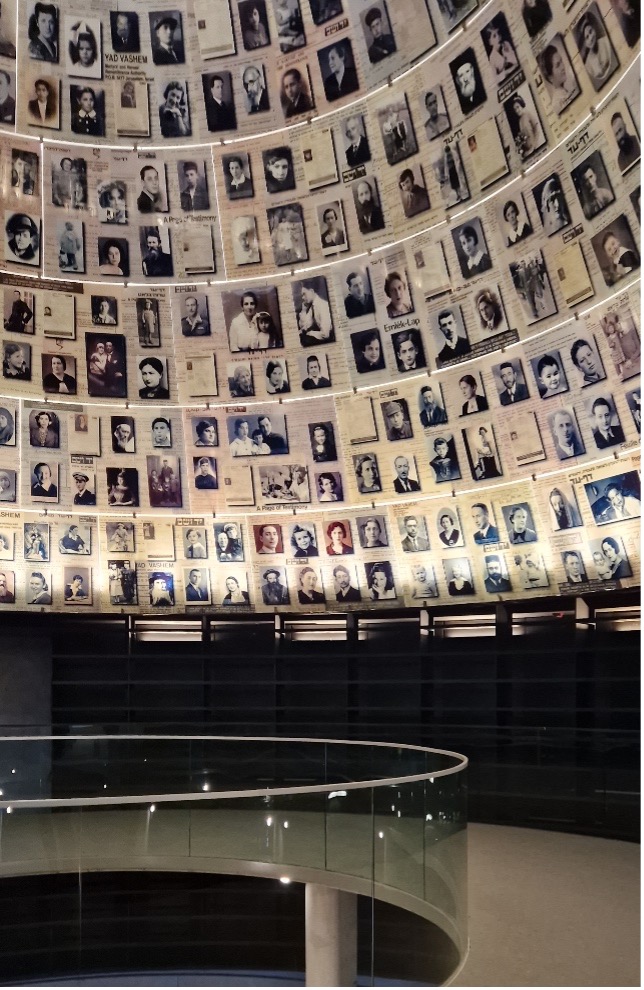
Most of the days the archive was quite empty with only few other visitors, mostly coming to search for some information on their relatives who either survived or were murdered in the Holocaust. They spoke all the possible languages and came from diverse backgrounds. But they all were connected by the tragic past of their families. And sometimes the Yad Vashem archive is the only place where the memory of these people, both murdered victims and survivors, is kept.
Photo: The Hall of Names at Yad Vashem, December 2025.
The Yad Vashem archive includes references to many other archives and often holds copies of their collections, making it one of the most comprehensive Holocaust archives in the world. Unsurprisingly, I found extensive material on “my” Jewish-Catholic couples, ranging from testimonies and transport lists to family photographs and postwar addresses in Israel and elsewhere. Particularly valuable was the documentation concerning Catholic spouses recognized as Righteous Among the Nations, which was often very detailed and included accounts by both the rescuers and eyewitnesses, as well as reflections on the rescuers’ personal motivations. The second part of my archival research focused on Polish-Jewish survivors who came to Sweden in the so-called White Buses, whose testimonies are preserved in the Ravensbrück Archive at Lund University Library (recently included in UNESCO’s Memory of the World register). I found information on many of them, especially in transport lists and records of inhabitants of Polish ghettos under Nazi occupation. However, I was surprised to discover that Yad Vashem holds neither copies of nor references to “our” testimonies. After arranging a meeting with the archivist responsible for the relevant collections, and in collaboration with colleagues at Lund University Library, Tomasz Leśniak and Håkan Håkansson, we initiated the process of signing an agreement to exchange data and digital copies of the Ravensbrück testimonies. I was very proud and excited to be part of this important development.
Time outside the archives was divided between meeting old friends, attending relevant events, and sharing my research while developing collaborations with colleagues from Israel and Palestine. One highlight was a seminar marking 250 years of Jewish life in Sweden, organized by Sophie Becker, Consul General of Sweden in Jerusalem, with distinguished speakers including Rebecca Krus (Berättarministeriet), Katty Hauptman (Holocaust Museum in Stockholm), and former Paideia director, Barbara Spectre.
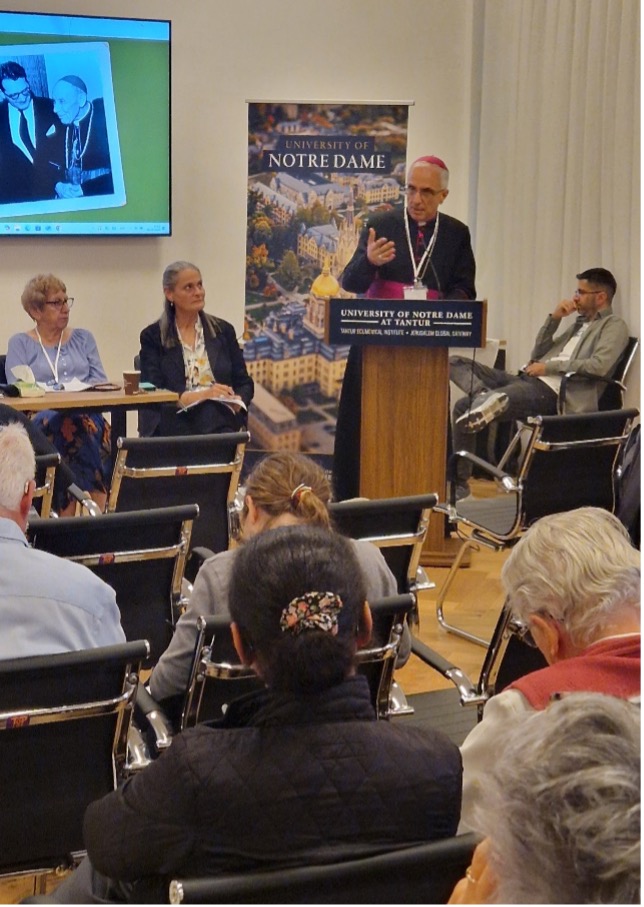
Another meaningful event was a conference on Nostra Aetate, where I encountered many familiar faces. I also greatly enjoyed sharing my current research on mixed marriages with colleagues and students at the Haifa Unit for Interdisciplinary Polish Studies.
Photo: A Catholic bishop of Nazareth, Rafiq Nahra, speaking at the conference Nostra Aetate in Their Age and in Ours, organized by the Notre Dame University at Tantur and Hebrew University of Jerusalem on 18-20 November 2025.
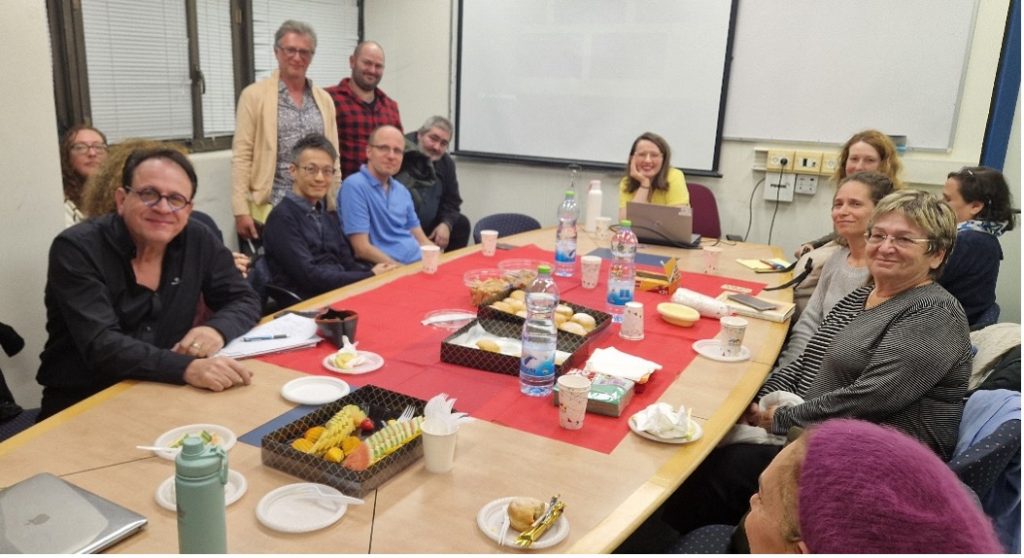
Photo: Guest lecture at HIUPS during Hanukah (therefore sufganiyot!).
Throughout my stay, the Swedish Theological Institute remained a safe haven, with its friendly and supportive staff and many inspiring guests and speakers, whom I was honored to meet. One particular highlight was learning songs for Luciadagen, then attending the performance and singing along.
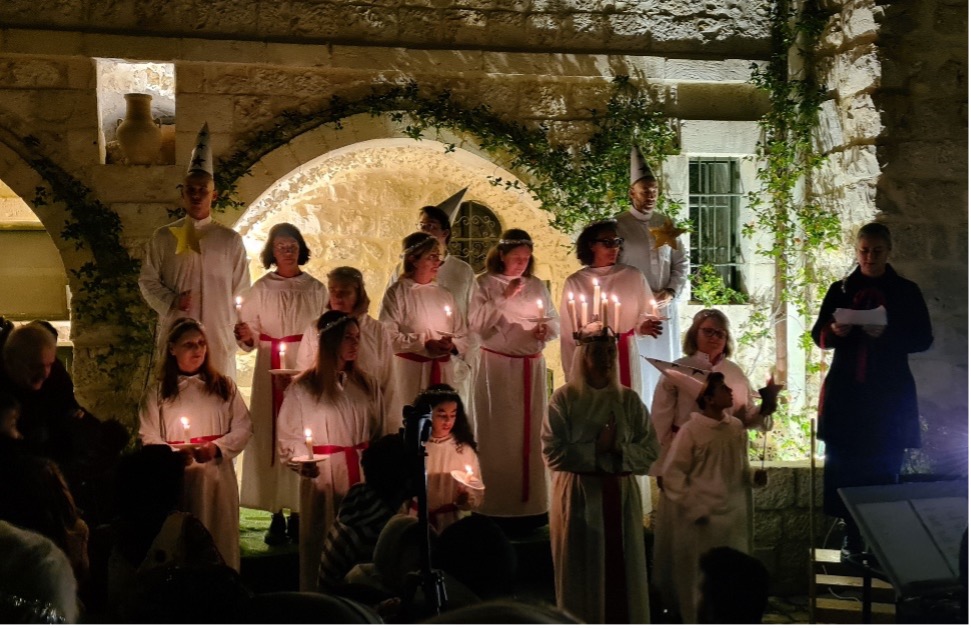
Photo: Celebration of Lucia Day at STI.
Despite these moments of community and shared learning, the period was marked by deep cognitive dissonance. On the one hand, daily life continues; on the other, violence and indifference repeatedly rupture its fabric. I will always remember visits to my warmly hospitable colleagues at The Smart University College for Modern Education in Hebron and at Birzeit University in Ramallah. Just two weeks after my visit to the latter, Israeli forces raided the campus, injuring dozens of students. Another striking dissonance was the absence of news about Gaza: I realized that, if I chose, I could remain in Jerusalem without ever hearing about the fate of Gazans.
